

In 2024, I wrote that New Zealand’s population centre had been shifting northwards for a century, in seeming contradiction of rising global temperatures.

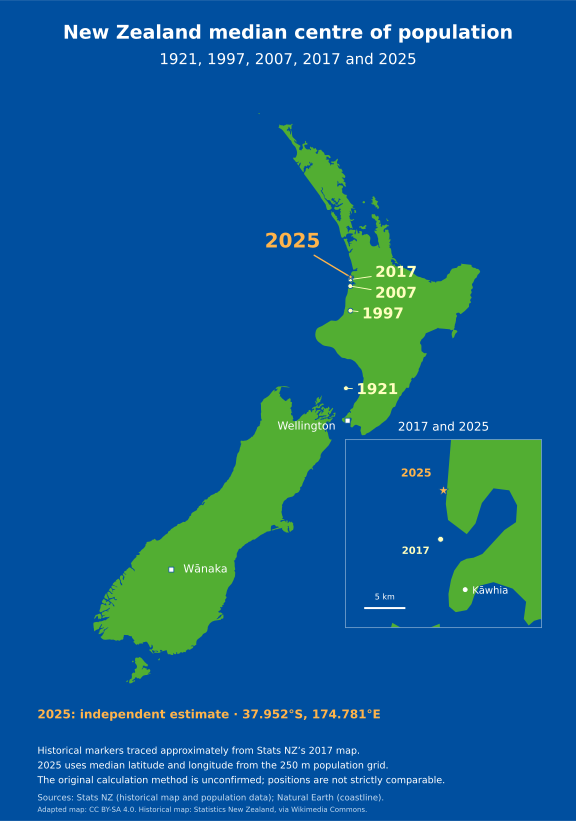
My post noted that the median centre of population in New Zealand moved 280 kilometres north between 1921 and 2017.1 My pick was that the 2023 centre of population would be north of the 2017 centre.

I promised to update readers as further data became available. Consistent with my prediction, between 2017 and 2025 the median centre of population moved approximately six kilometres further north.2 3
In more personal news, I’ve bucked this trend. I’ve moved from Wellington, my home of the past 20 years, to Wanaka in the South Island. It’s a move prompted by my advancing years, and wanting to be closer to skiing, tramping and volunteer conservation opportunities.
Economists are nowhere thick on the ground. To the extent that they do aggregate, they do so in capital cities, commercial centres, and university towns. Wanaka fits none of these descriptions.
I invite Asymmetric Information readers living in Wanaka and nearby towns, or just passing through, to get in touch for coffee, beer or a chat.
By Dave Heatley
»»»» Other posts by Dave Heatley


Strictly speaking, a population centre moving north doesn’t establish that New Zealanders are choosing to move north. Births, deaths, immigration and emigration can also shift the population centre. Nor does it prove a preference for warmer weather, though it is consistent with that preference.
I used GPT-6 Astra to help calculate population-weighted median latitude and longitude from Stats NZ’s 250-metre population grids. These are independent estimates. The 2017 position was traced approximately from Stats NZ’s published map, and its original calculation method has not been confirmed. Comparisons with that point are therefore indicative. The data and code are available on request.
Six kilometres is an estimate. The exact distance is uncertain because the historical position is approximate and the calculation methods may differ. Using a consistent method, I estimate that the centre moved about 2.4 kilometres north between 2023 and 2025.
Thanks, Dave! The mean location of the population, also referred to as the population centre of gravity, has been an interest of mine for a very long time. Back in 1981, armed with nothing more than a simple calculator, I calculated the demographic centres of gravity of both Australia and New Zealand. The latter, based on the 1976 Census, turned out to be somewhere offshore from Whanganui. That's consistent with Stat NZ's 1921 and 1997 points on your map (but which refer to medians rather than means).
I published the results in the Australian Population Association Newsletter, a sort of 1980s equivalent of Substack! I've now rescued the article from pre-internet obscurity and made it available here: https://www.researchgate.net/publication/417415291_AUSTRALIA'S_DEMOGRAPHIC_CENTRE_OF_GRAVITY_or_SHOULD_GRIFFITH_HAVE_BEEN_AUSTRALIA'S_CAPITAL
While the long-term northward drift of New Zealand's population is clear, there have been some interesting reversals. Between 2018 and 2023, the North Island's share of the population actually declined from 76.5% to 76.3%, with net internal migration of around 30,000 people from the North Island to the South Island. So, you are certainly not alone in responding to the South Island's pull!